Showing posts with label England. Show all posts

Monday, 25 April 2011

Alastair Cook and striking

Alastair Cook has been taking some stick for an interview he gave to the Times magazine on Saturday, in which he suggested that England’s cricketers may go on strike if the international schedule is not reduced.001

However, what the detractors have missed here is that Cook was not complaining about his own workload, but that of his teammates.

He even acknowledged that he is ‘pretty much the only one who’s been able to play and to enjoy the experience of winning.’

I would say he is perfectly justified in his complaints. This is a team game, after all.

I have more of a problem with something he says later, that he wants to ‘retain his low-keyness.’ If he’s serious about this, perhaps it might help to avoid top celeb photographer Rankin and the cover of the Times magazine?

Sunday, 6 March 2011

What exactly is a ‘good’ pitch? #cwc2011

So England, somehow, beat South Africa in Chennai by six runs. At one point, South Africa, chasing just 171 to win, were 124 for 3.

Fantastic, you may think. Yet another tight game at the World Cup. What more could you want from a game of cricket?

Well, quite a lot apparently. Simon Mann on Test Match Special said the pitch was not good enough. Jonathan Agnew went as far as saying that he hoped we wouldn’t see a similar pitch for England’s remaining group games, against Bangladesh and the West Indies.

But surely we must get away from thinking that the best pitches are those that are just good for batting. Aren’t the best pitches those that give an equal opportunity to both bat and ball?

And I think we came closer to that today in Chennai, than we did in the high scoring tie against India in Bangalore.

Saturday, 19 February 2011

England’s inglorious history at the World Cup #cwc2011

Some possible reasons why England have never won the World Cup.

  • 12 batsman have scored more than 1000 runs in the tournament’s history. None of them are English. Sachin Tendulkar tops the list, with a total of 1796 runs at 57.93.

  • 10 batsman have scored 150 or more in an innings at the World Cup. None of them are English. Incidentally, only 3 English batsman have ever scored more than 150 in ANY one-dayer – Robin Smith, David Gower and Andrew Strauss.
  • 9 batsman have scored 3 or more World Cup hundreds. None of them are English.
  • Mark Waugh scored 484 runs in the 1995-96 tournament. Seven batsman have scored more than this in a single tournament, but none are English.
  • No English batsmen appear in the list of highest partnerships for each wicket.
  • No English bowler has taken more than 30 World Cup wickets. 12 bowlers from other countries have done so (Glenn McGrath tops the list with 71).
  • 8 bowlers have taken 6 or more wickets in an innings. None of them are English.
  • No English bowler has ever taken a hat-trick at the World Cup. Five bowlers have performed this feat, including Sri Lanka’s Lasith Malinga who took four in four balls against South Africa in 2006-07.
  • No Englishman has taken 20 or more wickets in a single tournament. Nine bowlers have done so. 
  • England have never scored more than 350 in an innings. Six countries have, including India who scored more than 400 against Bermuda in 2006-07.

Apart from that, England have done really well at the World Cup.

Saturday, 4 December 2010

More on 1000 runs on a winter tour

#ashes #cricket After extensive research, I think I have uncovered the answer to my own 1000-runs-on-an-overseas-tour question.

The last man was the aforementioned Dennis Amiss, who scored 1120 runs on the MCC tour of the West Indies in 1973-74.

Regarding Ashes tours, the feat was last achieved by two batsman on the 1970-71 tour – Geoff Boycott (1535 runs) and J.H.Edrich (1097 runs).

Alastair Cook could soon be joining that esteemed company – 657 runs and counting.

An interesting #ashes -related statistic from @TMSscorer

Malcolm AshtonTMSscorer

No one has managed 1000 runs NOT in England in any calendar year. Closest is WR Hammond in 1933 with 883 runs

13 hours ago

ps Not sure if this Test or first-class runs, but I think Cook has beaten this record either way - 922 Test runs overseas so far this year, 1141 first-class runs overseas so far this year.

Wednesday, 1 December 2010

Alastair Cook - on course for an unusual achievement?

#ashes A statistic I always enjoy appears each year in the First-Class Career Records section of Playfair, where the penultimate column within the batting averages shows the instances of batsman scoring 1000 runs in a season (‘where these have been achieved outside the British Isles they are shown after a plus sign’).

Alastair Cook needs just 479 runs more to score 1000 in an overseas season

And it’s those numbers after the plus sign that I have always found particularly interesting. Nowadays its all overseas players such as H.D. Ackerman or Phil Jacques, but my 1983 Playfair reports that Geoff Boycott and Dennis Amiss both scored 1000 runs in an overseas season.

How they did this, I’m not sure - apart from England, Amiss only played for Warwickshire, and Boycott had just one season with Northern Transvaal in 1971-72. So an England tour seems the only way they could have reached the landmark.

So my question is - when was the last time an English batsman scored 1000 runs on an overseas tour with England? I ask, of course, because Alastair Cook has currently scored 521 runs in Australia, and still has five matches left to play.

Will the penultimate column of his career record in next year’s Playfair read ‘4+1’?

Wednesday, 24 November 2010

The PM's message to the England team


After watching this, I'm still not completely convinced that David Cameron is a real cricket fan...

Monday, 22 November 2010

Shameless plugging as the Ashes approaches

You know the Ashes must be coming close when articles about cricket start appearing in unusual parts of the newspapers. Standing out over the weekend was a half-decent interview with Stuart Broad in the Times magazine (although I wasn’t too sure about the sub-title – ‘the finest, most destructive English player of his generation’).

However, the piece was sullied by an italicized closing to which readers of sporting interviews are becoming more and more accustomed – Stuart Broad wears underpants by Primark, the official sponsors of England cricket underwear. Those weren’t the exact words, but you get my drift.

Even worse, a mention of his sponsors is crowbarred INTO the article –

in five short years…cricket has changed: more professional, more money, more sponsors (indeed, this interview is part of Broad’s contract with…)

Shameless.

And it’s not only the Times. The excellent new Wisden Cricketer has a big interview with Kevin Pietersen. While the main text is fine, the photos grate – the only way for KP to get more visibility for his sponsors would have been if he had painted three stripes on his forehead.

I know from my time at the Guardian that sports editors grapple with this dilemma. Do they give in, or do they hold out? Most give in. How much longer before the interview is conducted by the sponsor, and the journalist does nothing at all?

NACB is sponsored by Bubbles of Honor Oak Park, suppliers of alcohol and bread when Sainsburys is closed.

Monday, 15 November 2010

Does Graeme Swann really need a rest?

I feel foolish. Just last week, I wrote of the importance of the first-class matches on this Ashes tour away from the five Tests. And then England announce that they will in fact not be needing the services of their first choice bowling attack for the match against Australia A in Hobart on Wednesday.

Instead, Graeme Swann, James Anderson, Steven Finn and Stuart Broad will heading north to Brisbane, so they can ‘acclimatise’ before the first Test which begins in ten days time.

My initial reaction was to splutter in shock, and curse Andy Flower loudly. But, after further reflection, I understand that the coach is in an impossible position. Let the bowlers go to Brisbane early and a shoddy opening day in the first Test will be put down to ‘undercooking’. Play them in Hobart and one (probably Stuart Broad) is bound to get injured in a really stupid manner, like sliding into an advertising board when the ball has already crossed the boundary.

I can see the argument both ways. It’s one of those situations where we just have to trust the coach. This is Andy Flower after all, and the decisions he's made so far in his short career as England coach have been pretty damn good.

Tuesday, 2 November 2010

The importance of warm-up matches

The Press Association today reports a comment from Stuart Broad. ‘We know what an important week this is,’ Broad says. ‘We’re going to take the WA game [which begins on Friday] very seriously, and try and get some really good preparation in before the first Test.’

The importance of this attitude cannot be overestimated. The scheduling of three first-class games before the Test series begins on November 25th is a departure from recent tours, where the thinking seemed to be that less is best. None of those farcical, two-day, 14-a-side games for these tourists.

Warm-up games must be a good idea. Since England last won in Australia in 1986-87, England have toured Australia five times, and, of course, lost every series. Generally, the biggest margins of defeat occur after the shortest warm-up periods.


1986-1987      First-class matches played before first Test: 3. Won 2-1

1990-1991      Matches: 3. Lost 3-0

1994-1995      Matches: 4. Lost 3-1

1998-1999      Matches: 3. Lost 3-1

2002-2003      Matches: 2. Lost 4-1

2006-2007      Matches: 1. Lost 5-0


By allowing themselves time to prepare and acclimatise, England are surely giving themselves the best possible chance of retaining the Ashes.

Tuesday, 26 October 2010

England need KP. Or maybe they don’t

Everyone seems to agree that England need an in-form Kevin Pietersen if they are to hold on to the Ashes this winter. In fact, it’s been said so many times, it’s getting boring. But is it actually true?

Since March 2009, when KP scored his last Test hundred, England haven’t lost a Test series, and have lost just three of nineteen matches. Pietersen missed three matches through injury in the 2009 Ashes, and averages a less-than-great 35 from the others.

What gone wrong KP?

During this time, England have played a number of teams significantly stronger than the current Aussies, including the 2009 Aussies and South Africa in South Africa. The absence of KP has allowed the likes of Eion Morgan and Jonathan Trott to break through and hit match-winning hundreds.

So perhaps England’s best chance of success in Australia is not to pick KP first, and then fit ten players in around him. Instead, they would surely do well to pick the best eleven players - it’s revolutionary I know, but it might just work.

By constantly repeating the mantra that KP will come good, as if there must be trouble if he doesn’t, the England management are showing a weakness rather than a strength. And they will need all the strength they can muster if they are to beat their oldest foe once again.

Thursday, 21 October 2010

The boot camp conspiracy theory

Everyone loves a conspiracy theory, and NACB has good one for your delectation today concerning Jimmy Anderson and the England boot camp.

According to the ECB, Anderson ‘sustained a cracked rib during England's recent preparation camp in Germany’. Most media outlets went further and suggested his bowling partner Chris Tremlett punched Anderson a little too hard during a sparring session. Where this extra information came from is unclear.

Paul Collingwood and Monty Panesar go for a walk in Germany

But such is the intelligence and clearsightedness of Andy Flower and Andrew Strauss, that something doesn’t ring true. The England management would never be so stupid as to let the players thump the living daylights out of each other just weeks before the Ashes. Would they?

And why does the media release state that ‘it is anticipated that Anderson will be fit and available for selection for the first Test match against Australia in Brisbane’? Is such a speedy recovery from a cracked rib normal? And how come he has been seen playing golf and weightlifting in the Old Trafford gym since returning to the UK?

Could it be that the whole story is fiction? Perhaps it’s a smokescreen to deflect attention away from a problem somewhere else. Perhaps it’s an elaborate ruse to lull the Aussies into a false sense of security. We may never know, but there are dark forces at work.

So there’s no cracked rib, there were no sparring sessions, and Jimmy A will be roaring in to bowl on the first morning at the Gabba refreshed from a few extra hours in the steamroom. Never have I wanted to believe a conspiracy theory more.

Sunday, 26 September 2010

Eion Morgan – the new Michael Bevan?

After the disaster of England’s last tour to Australia, Duncan Fletcher was brave to write in Friday’s Guardian about his ‘strategy for Ashes victory’.

Andrew Flintoff being made captain, the return of Ashley Giles, the freezing out of Monty Panesar until the third Test - just one of those cock-ups from the 2006-07 Ashes might seem to disqualify Fletcher from this kind of talk.

However, for what it’s worth, he reckons the selectors should drop Alistair Cook in favour of Eion Morgan. This tactic seems to be predicated on the assumption that Morgan is pretty damn good at the one-day stuff, so he must be good at Tests as well.

Surely there is a flaw in this argument – success in one format does not necessarily lead to success in the other. Just look at Michael Bevan (below) – most observers’ choice as the best one-day batsman ever, he finished with a disappointing Test average of 29.07 (compared to 53.58 in ODIs).

Michael Bevan celebrates another one-day win for Australia

Fletcher talks of ‘performing under extreme pressure’, ‘a cool player in a crisis’ and ‘having a steady temperament’. Morgan undoubtedly has all these qualities, but maybe they aren’t quite enough to succeed in Test cricket.

Thursday, 23 September 2010

The tension is palpable. Not

So, not long to go until the Ashes squad is announced, and I am sure you are just as excited as me. Which is to say, not very.

There are two reasons for this lack of tension. First, England selection policy is now just so consistent. Do you remember when Joey Benjamin could make a winter tour? Or when England had four captains in one summer? Ah, those were the days.

The other reason is that the squad is not as important as it used to be anyway. When it needed a two-month voyage by boat to get Down Under, players knew that if they didn’t make the squad, their chance of playing was gone.

How England teams used to get to Australia

Now, it seems that half the professional cricketers in England will be in Australia over the winter, whether they make the squad or not. In particular, the Lions will be there for more or less the same length of time as the main squad.

This means, for example, that although Adil Rashid will probably only be in the Lions squad, his chances of making his Test debut this winter will probably be about the same as James Tredwell making the Test side, even though Tredwell may be in the Test squad.

I’ll still be listening to the announcement though. 2.30 on 5 Live, in case you’re wondering.

Friday, 20 August 2010

Catches really do win matches

The old adage that catches win matches has come to mind at a number of moments during this current series.

In the second Test at Edgbaston, Pakistan captain Salman Butt reckoned his side dropped fourteen catches. Pakistan were thumped. Has any side won a Test after missing so many chances?

Despite runs from Matt Prior and Azhar Ali, and more wickets for Graeme Swann, it could again be dropped catches that prove all-important in this third Test.

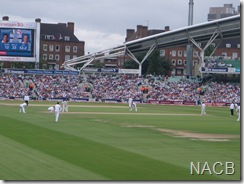
England strive for wickets in the second Test at the Oval

This time it was England who were culpable. With the score on 278, last man Mohammad Asif edged Steven Finn to Andrew Strauss at first slip. By Strauss’s high standards it was simple, but the ball was grassed.

Eight overs and thirty runs later, Swann finally took Asif’s wicket. By now though the lead had grown to 75 vital runs, and these could surely make all the difference in a low-scoring game.

A wicket so late in the day also left England with an awkward fifteen minutes to bat before the close of play. I wonder if that dropped catch was on Strauss’s mind, as he snicked Mohammad Amir into the hands of second slip? 

Monday, 16 August 2010

Surprise news: No chop for flop

I have unfollowed @CricketMirror on Twitter. When I saw this tweet earlier today, I felt I had to make a stand.

Selectors resist the temptation to chop flop Alastair Cook: England's settled side have been told to beat Pakistan... http://bit.ly/9LItSt

Did the selectors really ‘resist the temptation’? Did they ever really seriously consider dropping the Essex opener? Is he really a ‘flop’ (remember, he has a Test average of 42) or was it just a word that sounded good next to ‘chop’?

No, no, no and yes.

The possible dropping of Alastair Cook was surely never anything more than a media-driven time-waster. There hasn’t been much else to talk about for the last few days, but something had to fill all those newspapers columns.

A consistent selection policy is great for the team, but terrible for the hacks who find themselves scrabbling around for something, anything, to write about. I wonder what it’ll be before the fourth Test?

For decent tweets, follow NACB at http://twitter.com/NACBcricket

Friday, 6 August 2010

Follow-ons – not as good as they used to be (apparently)

Maybe my memory is planning tricks on me, but I seem to remember that captains always used to enforce the follow-on. If you had the opportunity to do it, you did it, no questions asked. And then you’d go on to win the match.

The famous exception to this was, of course, Headingley 1981. England follow-on 227 behind, score 356, and win by 18 runs.  But that’s what made it famous – it was so unexpected. In 1966 Tests, a team following on has only gone on to win the match on three occasions.

But now the possibility of enforcing the follow-on seems to only cause problems. It has become an opportunity for consultation, hand-wringing and head-scratching. To enforce, or not to enforce, that is the question.

Suddenly bowlers can apparently no longer cope with two innings in a row in the field. Suddenly batting on a fourth day pitch has apparently become even more difficult than it was before.

Two examples from the last week. In the first Test against Pakistan, most of the talk on the evening of the second day was about whether Andrew Strauss would put the Pakistanis back in if he could. In the end, the choice was taken from him, but the consensus, amazingly, seemed to be that England would have batted again anyway.

And then today at Cheltenham, Alex Gidman decided not to put Worcestershire back in with a deficit of 202 and a day and half left in the match. The GlosCricketBlog has a few thoughts on why he might have done it, but it makes no sense at all to me.

Of course, Gloucestershire may get the ten wickets they need tomorrow, and wrap up an easy win. But by taking almost forty overs out of the game to bat again, they have surely given themselves less chance of doing so. 

Glos v Worcs. scorecard from Cricinfo

Monday, 12 July 2010

Sunday, 11 July 2010

Allrounder update

I was interested to see Ravi Bopara, who has just been called up to the England one-day squad as a replacement for Ian Bell, described as an allrounder today.

The Essex man may have justified that description for his primary school team, but a career record for England in one-dayers of six wickets in fifty matches tells a different story.

If Ravi Bopara is an genuine allrounder, what does that make Paul Collingwood? The new Garry Sobers?